Richard Crary of The Existence Machine:
CBT: When I started this interview series it was already clear that publishing -- especially of literary fiction -- was in dire straits. At that time, one explanation that was fashionable was 9/11 was the reason people weren't reading as much literature (or as much anything) as they used to. Now we are living in a time when the long-term repercussions of 9/11 are still with us. But using 9/11 as a primary explanation for what ails literary publishing simply doesn't work. For one thing, we are now in the midst of a particularly serious recession, and for another, it is clear the general decline in reading is a widespread -- and possibly unstoppable -- phenomenon that has roots which go back decades.
What is your take on the current depressed state of literary publishing? Is it a passing phase (as the NEA's recent uptick of optimism implies)? Or is it an intractable problem -- in other words, it is the new normal? And if the latter, what can be done to counteract it?
RC: I don't think 9/11 ever had anything to do with why people were or were not reading literature--why would it have? The idea is silly on the face of it (though I realize it was said by many, just as we were told that somehow irony was now dead for the same reason; nonsense). There may have been a brief period in which there was an uptick in interest in history or politics, but that's about it. We hear a lot about this "general decline in reading", and it's easy to point to reasons why I don't read as much as I'd like: time spent on the internet chief among them, but also my lengthy commute, making me tired at home in the evenings, tv, movies, etc. And I'm someone for whom reading is very important. If it's less important, if it's just seen as another form of entertainment, reading probably is on the decline, since there are more and more distractions every year.But you mention the recession. I think that we're in the midst of something much worse than a recession, however serious. We've been riding a decades-long wave of ever-increasing consumption, in which we have grown to expect that we will always have access to everything, including new books. And yet it seems to me that even in those heady times, the practices of the publishing industry made little business sense. Publishing was probably kept afloat on a handful of popular selling novels (Harry Potter, Da Vince Code, etc) and other non-serious books, particularly as the larger houses became subsumed under larger, literature-indifferent conglomerates. Publishing entities that have flooded the market with all manner of right-wing political blather deserve to have much worse happen to them than simply going out of business.
CBT: How much potential do you think the Internet has as a vehicle of publishing? It's clear that there is a place for online criticism; the lit-blogosphere is dominated by it. The blogger Dan Green has even coined a phrase for this form of critical writing: the crit-blogosphere. But the crit-blogosphere's logical partner -- the fic-blogosphere -- is marginalized. Not many people read short stories or novels online. Will the Internet really become the medium in which serious people both publish and read fiction? Or is this a technological pipe-dream, and is it more a question of using the Internet as an effective means to sell and distribute printed books?
RC: I think it's a technological pipe-dream. I, personally, have no interest whatsoever in reading fiction online, unless the piece is a very short story indeed. I suspect that this a fairly common view.
CBT: It is arguable the Internet isn't effective as a medium for publishing long works of fiction because very few people can stand looking at regular screens for the necessary length of time. But e-ink provides a solution to this. It eliminates eye strain. How much potential do you think e-ink and e-book technologies have? Do you see e-books catching on with the public? And do they provide a reasonable business model?
RC: I'm skeptical. For my purposes, an e-book reader is an attractive option for downloaded pdfs, but I have a hard time imagining that I'd want to read too many books using one. Granted, as with much technology, it could be different with younger readers who will be more used to the idea. But it seems to me that, if the decline in reading itself is true, then e-books are not going to reverse the trend. Frankly, children like to handle books and turn pages. (Yes, they like gadgets too.) Another reason I'm suspicious of all the e-reader talk, and other technological solutions, is in fact the economic and environmental situation we find ourselves in. While it's true that book production (over-production, really), requires a lot of paper, and thus is another drain on trees (few ever discuss politics and industrial hemp in this context), it's also true that computers and by extension e-readers (or iPods) are just as reliant on the oil economy as other elements of the economy. I admit that part of my automatic response to what ails the book trade is not necessarily in the spirit of these interviews. I tend to believe that soon we're going to have to adapt ourselves to massive changes, huge downticks in consumption, which includes fewer books and electronics (the latter of which won't work at all without constantly available energy; not a problem for books). This kind of doom scenario may not materialize in my lifetime, but it will materialize, and it seems to me that failing to see beyond the immediate short-term has been hugely destructive in this country (and of course is a basic feature of modern capitalism) (and of which the practices of the publishing world are merely characteristic), so we may as well think about how to adjust before we, or our children, are forced to.
CBT: In the past few years, articles and blog posts (for example, at LitKicks) have appeared criticizing the pricing of books. Are books too expensive? Has this been a factor in reducing the size of the book-buying audience over the last twenty or so years?
RC: I'm not sure about this. Those who complain about book prices seem to believe that books operate independent of other economic factors. I used to marvel that books were so much cheaper in the UK than in the US, but then in my experience, American books are vastly better made than their UK counterparts. Better paper and other materials, better design, and so on. In addition, I think our expectation that we should buy every book we want to read is a factor here. I used to think this way, and it's more than a little nutty. I've only recently been making adequate use of the library, and it's been great. (Though I'm finding that I can't find a lot of what I want to read there, particularly if it's recent criticial, literary, leftwing political, or philosophical works--that is, the bulk of my interest in "new" books. So for these, I am indeed forced to either buy or go without.) So, books ARE too expensive, if you expect to buy everything you read, if only because it adds up. On balance though, no, I don't think they are. (Though, of course, books from academic presses, which includes much of what I cannot find at the library, books very often ARE too expensive, but I know there are reasons for that too.)
CBT: Staying with the same theme. Literary novels were once publishing in hardcover and then, several months later (and a spot on the best-seller lists willing), they were available as affordable pocket-sized paperbacks. However, in the 1980s this practice ceased and literary paperbacks started being published in North America as pricier trade paperbacks. Only genre fiction retained the pocket-book form. In retrospect, was this a prudent decision by publishers of literary fiction? Or should the literary pocket-book make a return?
RC: Was it prudent? I don't know. I like the trade paperback, esp. the well-made American ones (particularly those from publishers such as Dalkey or New Directions or NYRB) (though the more recent trend toward enormous paperbacks has not been to my liking); I think they last longer than the pocket books and are generally more attractive and provide a decent alternative to the hardcover. Now, whether it has made much business sense to stick to the hardcover so long, I'd imagine not. Paperback originals are a good idea.
CBT: Agents now have enormous power, effectively controlling which writers get access to acquisition editors at major houses. Furthermore, agents find themselves under enormous pressure, acting as the line of first readers who have to sift through avalanches of submissions. Is this tenable over the long run? Is it good for art? Or should large houses be accepting both agented and unsolicited submissions?
RC: I don't know much about agents, nor do I much care about them. However, I would say large houses, which is to say large corporations, are not good for art, period.
CBT: Literary prizes have also grown in power. They have arguably replaced the glowing review as a marketing tool. But are they as effective as criticism in building a contemporary canon? After all, critics can express nuance, prizes can't. Do book prizes give the message: this books is worth reading and all these others aren't?
RC: I have, on occasion, allowed prizes to help determine my reading. I wasn't reading critics at all when I started reading and prizes seemed like an acceptable way to go. They brought books to my attention I otherwise wouldn't have known about. I did ok for a while. But as my tastes have matured, I have found that the prize-winning books are rarely all that interesting. With exceptions of course. In general, I now find the focus on prizes silly. I don't care about them, at all. Now, most of the new books that come to my attention are due to a small cadre of trusted bloggers and a handful of critics.
CBT: Thinking of your own site, what sorts of changes do you foresee in it? Are blogs destined to become the new magazines? Will you start using a format (and possibly working with partners) in a magazine-type way? Or is blogging as it's currently defined how you want to keep posting work on the Net?
RC: My blog is a very personal endeavor. While I respect some of the online efforts other bloggers have undertaken, I'm highly unlikely to make changes such as you describe. It's all I can do to maintain my current level of activity! The only change I'd LIKE to see happen, is my having more time to devote to ideas that occur to me but which I have all too often been unable to develop.
bio: Richard Crary is a lit-blogger and critic. You can find him at The Existence Machine.

Conversations in the Book Trade: Books, art, art-books, and ... authorial movies.
Monday, July 20, 2009

Thursday, July 09, 2009
John Reed
My interview with John Reed is now up at Rain Taxi. In it, we discuss Reed's "new play by William Shakespeare", All the World's a Grave, as well as hierarchies on the Internet, and the effect of literary prizes on the formation of a contemporary canon.
Tuesday, June 23, 2009
Monday, June 22, 2009
Sunday, June 14, 2009
[note: this originally appeared in Dark Sky Magazine]


BARAM WRITER
EXT. AN URBAN WOODLAND. WINTER. LATE AFTERNOON.
Wind blows through trees, rustles dead leaves, makes branches sway in a creaking, slow dervish.
VO [male]: The wind has its own tone, its own feeling. It’s like … coldness, thinness.
It’s like hunger.
The wind has a body. The wind is someone.
JUMPCUT
EXT. A HIKING TRAIL IN THE URBAN WOODLAND. A MOMENT LATER.
A married couple walks along the trail. We see the wife, walking ahead.
VO: You’re someone. I’m someone.
Your body: petite, a source of warmth. A body to whom love is directed.
My body?
Wind.
That is, has been wind. Still feels like wind, but sometimes feels warmth.
I think this is the final state of love.
JUMPCUT
EXT. THE HIKING TRAIL. A MOMENT LATER.
A view of nearby apartment buildings. Several of the apartments, while still in somebody’s possession, lie empty. The buildings look spectral and aristocratic: the second homes of the well-to-do. The empty homes of the well-traveled.
The couple on the hiking trail, dressed in their simple clothes, look at the buildings.
HUSBAND [in accented Korean]: 열령 집. [”Ghost houses”]
WIFE: They go somewhere, maybe to Swiss.
HUSBAND: We should go on a trip sometime. Get away.
WIFE: I can’t. I have too much stress at hospital.
HUSBAND: I know. That’s why we should go. Your job is too difficult.
The WIFE looks at her HUSBAND. She sadly shakes her head.
JUMPCUT
EXT. THE HIKING TRAIL. A MOMENT LATER.
The HUSBAND follows his wife. He follows her along the trail as the cold sun sets.
VO: You walk along the trail, together today, but tomorrow, Sunday, you have to work an evening shift.
EXT. THE HIKING TRAIL. THE NEXT DAY. DUSK.
VO: I’m alone.
I walk along the trail. My daily exercise.
The scene is still, quiet. Thoughts pour through my head.
I’m worried about you. Your job is too hard. It’s affecting your health.
The sensation is like wind, a stress-wind, blowing the chemistry of the mind in circles.
Worries swirl like brittle, dry leaves.
A new sensation comes to me. It’s a sensation that combines worry and love. It is a sensation in the bones. It radiates through muscle, through organs, through eyes. It’s a reverse heat, as if the body burns from its core.
It’s more than heat. It possesses a force, subtle yet existent in the world, which collides with our lives: it is an interior shake, an earthquake of marrow. It’s the wind of reality. And it has made an impact.
The body must withstand this impact. The body must marry the mind, tell itself the wind is weak, not the person it shakes.
JUMPCUT
EXT. THE HIKING TRAIL. A MOMENT LATER.
VO: The sun sets behind trees. Blackness descends upon the world.
The sun sets and the wind dies. It retreats to its apartments, its clouds.
Screenplay-novel FAQs
What is a screenplay-novel?
The screenplay-novel is not a selling out. Think of it this way: there are good movies. There is good TV -- especially outside a North American context. In other words, both mediums are capable of producing genuine works of art, despite their group-made natures. If you write a screenplay-novel, you should try to make something that also has artistic merit. Obviously, it won't possess descriptive passages to the same degree that great traditional fiction does. But this does not mean the screenplay-novel must diminish a good writer's requirement to produce (or good reader's requirement to be sensitive to) linguistic originality. The screenplay-novel is intended, above all, to re-invigorate the relationship that exists between writer and audience.
When reading a screenplay-novel, people can read it as a director might. This is one of the broad-based effects that movies have had on the modern mind: it is possible -- even natural, it sometimes seems -- to think "cinematically". In other words, our minds have already been conditioned to imagine narratives as if they were movies. Maybe everyone doesn't do this. But many people do, and they do it effortlessly. In this sense, we are all directors now.
The trick is to be a good director -- an auteur, if you will. The need for this is especially pressing these days as the role of the auteur has been severely diminished within the movie industry generally. And that's an irony that stands in favour of the screenplay-novel: movies are becoming too expensive and formulaic for auteurship to genuinely thrive within movie-making itself. Therefore, a creative individual with the sensibility of an auteur needs the book. He or she needs the artistic freedom that the book still can provide.
It's worth noting that the best movies and TV that squeeze through the system are often made in opposition to mass culture. The screenplay-novel is another way of doing that.
But what about reading? If everyone is "being a director", won't reading suffer even more?
People are still reading lots these days. The trend among readers, however, is to buy more non-fiction than fiction.
What's wrong with that?
Nothing in the sense that non-fiction has always been popular, and now simply is more so. However, we still need fiction. It's not a luxury. It's a necessity, as well. It's something of a cliche to observe that cultures rise and fall based partly on the stories they tell themselves. It might be more accurate in a 21st Century context to point out that cultures wage wars -- or passively witness them -- according to the stories they tell. (This, incidentally, is one theme of my screenplay-novel TRUTH MARATHON.)
It's a novel. But it's written in the form of a screenplay.
How did you get the idea of writing a screenplay-novel?
Over time, it dawned on me that I treated movies the way I treated novels: I would appreciate their stories in a similar way, and talk about them afterwards the way a person might talk about a novel. In fact, I do this more often with movies ... mainly, I think, because nowadays movie-watchers vastly outnumber novel readers and so there are many people you can have a conversation with about a particular movie -- even a very serious movie. It's a lot harder to do that about a particular book.
The epiphany occurred when I was
I live in South Korea
[N.B. It's worth noting that some time after reading this book for the first time, I noticed it didn't in fact contain stills plural, but the same photo from the movie over and over. However, the point still stands -- an artistic experience similar to that of a movie can be created in book form.]
And then there's the creative process involved: Unless writing autobiographically, I like imagining scenes as if they were in a movie. My imagination seems to naturally work that way.
Has this idea been done before?
There's a long tradition of writing satire in the form of a screenplay -- you know, some comic scene, for example, an inane conversation in the White House. And there is a tradition of teleromans in some countries. These are basically comics made of photographs, not drawings.
But there are no examples of a literary novel written in screenplay form that I've seen. At least, this was true when the idea first came to me. Since then, people have given me examples. One was a script by Michael Turner entitled "American Whisky Bar". I haven't read the book, so I can't comment on it. But some time after it was published, it was produced by CITY-TV and Bruce McDonald as a live television drama. I saw that broadcast. The broadcast was really more like a 1950s-style televised play than anything else. So I don't know if it qualifies.
Personally, I think people will come up with other examples and this will turn into a long-running debate over who was first. And I doubt it will ever be satisfactorily resolved. Instead, what I'd like to emphasize is I'm calling for the screenplay-novel to exist as a distinct form of novel. In other words, I'm hoping that many serious writers will adopt this way of writing novels -- at least, for some of their work.
So it's a good idea because it's new?
Ideas aren't good simply because they're new. I might be the first person to invent chocolate-flavoured cheddar cheese. That doesn't mean it's worthwhile. Instead, I think this idea is good because it has the potential to be artistically effective. It solves problems for the writer, and solves problems for the audience. Although it should be written with care and craft , because its word count tends to be lower than in a traditional novel, it's quicker to produce and quicker to read. Yet at the same time, it keys into people's imaginations. It is a very effective way of creating the vividness necessary for certain types of narrative, especially those emphasizing dialogue.
Of course, some people don't feel the same way. For them, the screenplay-novel is not a particularly evocative way of writing. They need more in the way of description -- both of the environment and of interior consciousness. I understand this. Because the screenplay-novel is stripped-down, it seems to have certain inherent shortcomings, one of which is less physical description and the other which is the apparent disappearance of interior consciousness.
So it's important to underline the first quality can still exist in a screenplay novel. As in a regular screenplay, there is no necessary restriction on the number of descriptive passages that exist. There are simply conventions about this, just as there are conventions in what might be called traditional screenplay writing; screenplays tend to be very minimalist. However, a screenplay-novelist doesn't have to follow this convention. He or she can include as many descriptive passages as he or she wants.
Evoking interior consciousness is more of a problem. Interior states of mind don't "disappear" in a screenplay-novel. Instead, they have to be evoked mainly by the characters' dialogue. (This is one reason why I tend to use more description of gestures, facial expressions and tone of voice in my dialogue than you'd find in a regular screenplay.)
The screenplay-novel form is not perfect. It has strengths and weaknesses. But let's be honest: the traditional novel has short-comings, too, not the least of which is its increasing tendency these days toward self-consciousness and overripe writing (or over-write writing; a lot of books suffer simply from being longer than they need to be). It is a sad irony of contemporary fiction that just as the novel is facing so much competition from other narrative forms -- from movies to video games -- so many novels that are published are either strait-jacketed by convention or so self-indulgent and flabby that they fall into the category of books that can be opened but not finished. This is one of the real strengths of the screenplay-novel: it is designed to be finished. It is designed to succeed in keeping its audience's attention. There is something shameful and affected in insisting this is an irrelevant goal for the serious writer to keep in mind.
(And I cannot keep repeating often enough: the screenplay-novel does not have to eschew fine writing; belles lettres can exist within its pages -- it is just that belletristic description is kept to small proportions, unless those belles lettres arise naturally in a character's speech.)
You mentioned interior consciousness. This is exactly what I like about novels. How can a screenplay ever compete with that?
This is probably the most complex aesthetic question that one can ask of the screenplay-novel as a form. As I suggest above, interior consciousness does not "disappear" because putative descriptions of it disappear. In other words, interior consciousness -- or rather, consciousness generally -- when evoked in art can be revealed many different ways. A good stage play tells us a lot about characters' interior consciousness; it does this through dialogue that takes place in more-dramatic-than-one-finds-in-regular-life situations. In other words, even though a stage play generally does not attempt to "show" interior consciousness, it can quite effectively evoke enough of the characters of various dramatis personae that we, the audience, develop a sense of both the outer and inner life of the people on stage. (Furthermore, just as staged theatre can, to a degree, and through the artistry of well-written dialogue, tell us something about the interior consciousness of characters, so traditional novels can fail at successfully evoking it. It's also worth noting that a fair percentage of "interior consciousness" that one finds in works of conventional fiction is simply not very convincing. More on this in a moment.)
When we talk about interior consciousness in art, we are not talking about something that reflects with absolute accuracy an already existent state(s) of mind. Instead, we are talking about a mimetic process; an attempt on the part of art to capture something that is "real" -- if consciousness can be said to be real in the way we normally understand that word. Quite often, this mimetic process falls short.
All this would be fine if literary people could reach some kind of genuine consensus about when writers succeed and when they fail at depicting interior consciousness. But they can't. What this means for defenders of traditional literature as a repository of "something that movies can't do" because, so their argument goes, only literary fiction can evoke interior consciousness, is a need to re-think just what it is that allows a work of literary fiction to tell us about various characters' inner lives. Showing inner life is not as simple as claiming one shows it; a work of art has to do more. And this is something screenplay-novels can succeed at doing as well, if they are written well enough.
I've read other screenplays, and they're a lot different from yours. Why?
Those aren't screenplay-novels, they're screenplays. They are meant to be produced into movies. What I'm doing here is a novel meant to be imagined as a movie.
Why don't you just write a regular novel?
I do. I have. But recently I have become interested in this approach to -- this form of -- writing. It's a method of writing that works for me; that re-inspires me after years of increasing frustration with traditional literary techniques.
So you hate traditional fiction?
No. When it is well done I admire it just as much as I ever did. Traditional fiction (which could be called conventional fiction, but here I really mean to say literary fiction in the form in which we usually find it) has been what formed me: this is true from 19th Century geniuses like John Keats, Charlotte Bronte, Oscar Wilde, Edmund Gosse, and Fyodor Dostoevsky, to the extraordinary richness of 20th Century literature -- including giants such as Franz Kafka, Virginia Woolf, Theodore Dreiser, Evelyn Waugh, Philip Roth, Saul Bellow, Mary McCarthy, Simone de Beauvoir, Doris Lessing, James Baldwin, Ernest Hemingway, Graham Greene, J. D. Salinger, Isaac Bashevis Singer, and Leonard Cohen to lesser knowns such as Bruno Schulz, Tadeusz Borowski, Knut Hamsen, Ole Edvart Rolvaag, Sigrid Undset, Violette Leduc, Elizabeth Jane Howard, David Plante, Daniel Jones, Harry Sonny Ladoo, and Britt Hagarty, to artist/writers such as R. Crumb, Peter Bagge, Julie Doucette, Chester Brown and David Collier, to recent discoveries among Korean writers such as Chai Man-shik, Oh Jung-hee, Chae Yun, and Yun Heung-gil ... the list goes on and on.
In the period described above, there's such an enormous quantity of good writing that at times one might be forgiven for thinking that "good writing" is for the recent historical period like "progress" was in the late 19th Century: something we can take for granted. The early days of the 21st Century, however, indicate an opposite trend. Much fiction that is getting published and praised these days has a tired, predictable quality.
If I were the only person who felt this way, I'd blame myself. But many people who are serious about reading feel the same way. When best-of-year reading lists are drawn up, one often hears the comment that a particular book which won major prizes or was promoted by establishment taste-makers was a disappointment. There is a malaise affecting contemporary fiction, and this malaise is corroding the faith that people at all levels of the literary enterprise have in the process of producing literature. Agents are taking on less literary fiction than they used to, publishers are publishing less of it, and writers are finding their careers stymied when the sales of one book just don't materialize and they find it difficult to sell their next manuscript. (Or else, their careers are stymied by not being published at all -- and yes, this happens to good writers.)
But being a writer has always been difficult. Why complain about that?It's not so much a complaint as an observation that the cultural landscape is in the process of changing rather drastically. This isn't news. The readership of fiction, especially literary fiction in its traditional form, has been declining for years. Recently, this decline has become alarming. By all means, read traditional novels, and, if they move you, venerate them. But we have to face the larger cultural reality. We have to think in new ways.
So why don't you just watch movies and TV?
I like movies ... TV I'm not so sure about, although there are good programs out there.
The problem with movies and TV is this: they cost a lot to produce. No, let me rephrase that -- they cost an astronomical amount. Apart from the indie movie scene, which tends to be perpetually marginalized, no one individual can make them. They are group efforts, and while this gives them some strengths, they suffer from the near-inevitable tendency of group creations to lose any singular voice. And it's the singular voice that has to survive. It's the individual consciousness, not the group, that maintains contact with life.
And this is one of the great strengths of books: because they're relatively cheap to produce, they can still be made by individuals. (The contemporary trend toward "packaging" a book is pernicious on so many levels, as the Kaavya Viswanathan incident showed. Whether this scandal will be enough to stop the general trend to package books and turn even them into bland, committee-made products remains to be seen.)
Mass culture, with its converging technologies such as TV-receiving cell phones and ubiquitous WiBro reception, keeps moving more and more toward post-literacy. We are in desperate need of narrative forms that both can reach an audience but also allow the artist to retain his or her individuality. The screenplay-novel is a way of "writing a movie".
The screenplay-novel is not a selling out. Think of it this way: there are good movies. There is good TV -- especially outside a North American context. In other words, both mediums are capable of producing genuine works of art, despite their group-made natures. If you write a screenplay-novel, you should try to make something that also has artistic merit. Obviously, it won't possess descriptive passages to the same degree that great traditional fiction does. But this does not mean the screenplay-novel must diminish a good writer's requirement to produce (or good reader's requirement to be sensitive to) linguistic originality. The screenplay-novel is intended, above all, to re-invigorate the relationship that exists between writer and audience.
When reading a screenplay-novel, people can read it as a director might. This is one of the broad-based effects that movies have had on the modern mind: it is possible -- even natural, it sometimes seems -- to think "cinematically". In other words, our minds have already been conditioned to imagine narratives as if they were movies. Maybe everyone doesn't do this. But many people do, and they do it effortlessly. In this sense, we are all directors now.
The trick is to be a good director -- an auteur, if you will. The need for this is especially pressing these days as the role of the auteur has been severely diminished within the movie industry generally. And that's an irony that stands in favour of the screenplay-novel: movies are becoming too expensive and formulaic for auteurship to genuinely thrive within movie-making itself. Therefore, a creative individual with the sensibility of an auteur needs the book. He or she needs the artistic freedom that the book still can provide.
It's worth noting that the best movies and TV that squeeze through the system are often made in opposition to mass culture. The screenplay-novel is another way of doing that.
But what about reading? If everyone is "being a director", won't reading suffer even more?
People are still reading lots these days. The trend among readers, however, is to buy more non-fiction than fiction.
What's wrong with that?
Nothing in the sense that non-fiction has always been popular, and now simply is more so. However, we still need fiction. It's not a luxury. It's a necessity, as well. It's something of a cliche to observe that cultures rise and fall based partly on the stories they tell themselves. It might be more accurate in a 21st Century context to point out that cultures wage wars -- or passively witness them -- according to the stories they tell. (This, incidentally, is one theme of my screenplay-novel TRUTH MARATHON.)
I still think screenplays suck. Traditional novels are more interesting to read.
Thursday, June 04, 2009
How Can We Read in an Age of Images? [proto-remix]
The following are the opening paragraphs of an essay I wrote a couple of years ago for The Quarterly Conversation. I'm posting it now partly because I have been meaning to re-work some of its ideas and not getting around to the task, and therefore am hoping to prompt myself to do so. I'm also posting it because I think its arguments remain timely, if, admittedly, in need of refinement.

How Can We Read in an Age of Images?
The Quarterly Conversation, Fall 2006
Typically, a litblog’s traffic pales in comparison to image-based sites. For example, I recently came across one called The Sartorialist. It’s based on a grabby idea: just a series of snapshots of people who are in some way well-dressed, with commentary underneath. And then when I looked at the number of profile views the site had received, I—well, I blanched with envy.
Even more heavily visited, of course, are the big name sites with enough corporate dough behind them to generate high-octane buzz. Otherwise sensible newspapers such as The Washington PostThe Guardian have blogs that deal with literary subjects. But while these latch onto the cool of the blogosphere, they do not partake of its democratic nature. Therefore, you, dear reader, are supposed to visit these sites, but they will not visit you.
And then there are the “bloggish” big-money sites. These are not even blogs at all—they are homepages attempting to manufacture their own street cred. An example of this is a site I recently saw put together by the BBC for a white hip-hopper. Grabby, for sure. But its grabbiness proceeded precisely from its use of image, and its images were effective because they were assembled by well-paid designers.
In any case, the question of the power of the image—the great seduction of looking—is one that litbloggers have to wrestle with. Some dispense with images altogether. Some use them tastefully. Neither approach is better than another, since it’s important to remember litblogging is time consuming and almost always a labor of love. No point criticizing blogs for not doing things they’re not intended to do.
But here’s the thing: litblogging, like literature itself, is currently caught in a death struggle with the powerful draw of the what-can-be-seen. Simply put, images pull away readers. They seduce them. We know this. There is an entire body of theoretical work devoted to the subject. But literary fiction tends to shy away from the trend of image-based culture, which not only venerates the image, but venerates the attractive image.
And this is what it comes down to: the power of the image to attract. The power of the image to override all common sense and—oh! it’s embarrassing to even admit one aspires to this!—seriousness. And these images do not even have to pretend to have any high-brow value. They are just there . . . an addictive click away: the Victoria Secret homepages, the bikini thumbnails, the travel ads (more bikinis)—all the images that really aren’t interested in the attitude or education of those who view them, because they know that in the end none of these things matter. Only desire does. Desire is the great emotion of our time. It is more powerful than thought. And all we can do, then, is think about it; try to make some sense of a feeling that is inescapable but not unmanageable.

Tuesday, June 02, 2009
Thursday, May 28, 2009
Altruism
The Fresh Air Fund -- a charity that helps inner-city kids enjoy nature during the summer -- is looking for assistance. Click here to learn more.
Tuesday, May 26, 2009
August C. Bourré of Vestige, The Wooden Fish
CBT: When I started this interview series it was already clear that publishing -- especially of literary fiction -- was in dire straits. At that time, one explanation that was fashionable was 9/11 was the reason people weren't reading as much literature (or as much anything) as they used to. Now we are living in a time when the long-term repercussions of 9/11 are still with us. But using 9/11 as a primary explanation for what ails literary publishing simply doesn't work. For one thing, we are now in the midst of a particularly serious recession, and for another, it is clear the general decline in reading is a widespread -- and possibly unstoppable -- phenomenon that has roots which go back decades.
What is your take on the current depressed state of literary publishing? Is it a passing phase? Or is it an intractable problem -- in other words, it is the new normal? And if the latter, what can be done to counteract it?
AB: I honestly hope that it's a passing phase, but I very much doubt that it is. There are so many factors involved in how the industry got into its current state -- a lot of which I'm no doubt not even aware of, since I've largely stayed isolated from the business end of things, my background being academic -- that it may be impossible to fix it without just burning it to the ground and starting over. (I'd rather that not happen, but if wishes were horses, etc.) If the last few months are any indication, market forces may be doing that for us.
Guy Gavriel Kay wrote a great essay for Queen's Quarterly back in 2001 ("Privacy and the Ethics of Literature", 108.1, Spring Issue) about the ethical dilemmas involved in what we've come to call "appropriation of voice". His central argument, if I recall it correctly, is actually quite relevant to this discussion, or at least part of it is. He suggests that because we've let mainstream media get away from its role as a place for serious, moderated, and most importantly, heavily scrutinized (by editors and other professionals) information and art, and let it become instead a place for short-term cash grabs, with celebrity gossip on CNN and countless hours of voyeuristic reality programming on nearly every channel, we've become a society of entitlement. A remarkable crassness and selfishness has entered our cultural consciousness. That's not to say that those elements weren't always there; of course they were. But they were, if nothing else, things that helped us set limits, things that we were properly ashamed of when we took them too far, when they took control over us instead of being tools with appropriate circumstances for application. That's not so anymore; we want everything, and are ashamed of nothing. Reading, and literature in particular, has in my opinion always been, as Harold Bloom said in How to Read and Why, "the search for a difficult pleasure" (p. 29). But with our beefed-up sense of entitlement, we no longer see that sort of thing as a challenge or an adventure. It's just another thing that stands between us and our demands, our requirement for instant and total gratification. If I had a dollar for every time I've seen someone I know justify horrible attitudes and behaviours with the words "I want" or "I'm bored", I'd never have to work again. It's that sort of thing that allows people like Judith Regan to not only have careers in publishing, but to rise to positions of power and authority. If nothing else, we've proven, as an industry, that we're capable, and even willing, to behave as poorly as the vicious sons of bitches who demolished the housing and money markets for short term gains. The stakes just aren't as high for us. It may bring in more money in the short term, but flooding the market with celebrity trash, barely-edited thrillers, and ghost-written novels under the names of long-dead "franchise" authors, and then ignoring the literary efforts of nearly anyone not named Atwood, Ondaatje, Updike, or Roth, can't be healthy.
Of course that's just one factor. While the industry seems to have embraced crass commercialism (massive corporate consolidation doesn't help) with a vengeance, it's been stupid about new technologies. Publishers, for the most part, ignored the lessons they could have learned from other industries (from the music and movie industries in particular, and even the web design and development industries), and ignored the opportunity to develop intelligent, reasonable standards for digital formatting, distribution, and pricing. Instead they stuck their heads in the sand and behaved like the notorious luddites they're reputed to be, and only acted when they finally felt backed into a corner by pressure from Amazon and tech-savvy independent authors and houses. The resulting over-priced mess of conflicting hardware, encoding formats, and DRM (here's a hint: the lesson you should have learned from music and film is that DRM does nothing but piss off your customers) will take us years and a tonne of cash to sort out, and in the meantime will cause no end of headaches for publishers, distributors, and readers alike. Melville House in the US and House of Anansi here in Canada both seem to be doing a good job of balancing quality, commercial viability, and traditional publishing with digital distribution and promotion, though I don't think either of them have figured it out entirely. Coach House Books seems to be pulling it off too.
Can anything be done to counteract those things? I think so, but it's not going to be one single thing. Publishers (by which I mostly mean large, corporate houses) need to take a good, long hard look at how their acquisition, promotion, and distribution systems work, and why they've made the choices they have. Long-term strategies need to be developed and implemented for dealing with the new technological end of the market, and their over-reliance on a stable of aging "blockbuster" authors needs to be adjusted to properly develop new and interesting voices. I think the biggest thing that will need to be done is to change attitudes: what we need is a healthy industry, and healthy doesn't necessarily mean "making as much money as possible right now", it means being supple, making reasonable profits in an environment with a long-term plan for stability so that there's room to explore new opportunities when they present themselves (ie. don't be so focused on short term profits that you ignore new developments until they run over you like a cement truck).
I haven't said much about book sellers, but I thought the next question was more appropriate for that.
To be honest, thinking about some of these things gives me a bit of a headache, and I'm not sure that I have the necessary background to give my opinions any real validity. I'm very much just an industry outsider who would rather be a participant. The problem with that, is that it makes me look maybe a bit too hard at the thing I want to be involved with, and I sometimes think that I lose perspective. It's one of the reasons I stick to writing about individual books on vestige.org.
CBT: How much potential do you think the Internet has as a vehicle of publishing? It's clear that there is a place for online criticism; the lit-blogosphere is dominated by it. The blogger Dan Green has even coined a phrase for this form of critical writing: the crit-blogosphere. But the crit-blogosphere's logical partner -- the fic-blogosphere -- is marginalized. Not many people read short stories or novels online.
Will the Internet really become the medium in which serious people both publish and read fiction? Or is this a technological pipe-dream, and is it more a question of using the Internet as an effective means to sell and distribute printed books?
AB: My first response was very Bill Clinton-esque. I wanted to say "yes, and no", and "it depends on what you mean by 'effective'". The Internet is a big place with a great many aspects. When we say "the Internet" like this, it's most often a shorthand for "World Wide Web". But "the Internet" isn't just the hypertext protocol, it's email, bittorrents, IRC, Telnet, Hotline, FTP servers, the iTunes Music Store, the Amazon Kindle, ATMs and Debit/Credit point of sale systems, SMS and other alternative forms of telephony, and a tonne of other systems and protocols. I think at some point we will see fiction take hold on the Internet, as it seems to be doing in the US with the Kindle. I just don't think it will happen on the World Wide Web. There's a variety of technical problems that would need solving to make WWW distribution feasible as a major player (as opposed to, say, PDF downloads and what not). There's a tonne of issues with browsers, monitors, typeface reliability, mobile devices, and so on that make print-quality typography impossible on the web (though Web typography is no longer the nightmare it was even five or six years ago). I think that if digital distribution (or "the Internet") does become a major part of how people read fiction, it will more likely be though a platform like the Kindle or the iPhone than through the Web. In part it's because there's too much going on with the Web, so much more than there is with a dedicated reader (or a portable device like the iPhone). There are issues of comfort, of course, like how reading on a screen can be hard on your eyes, and on your back, if you've got a desktop unit. But fundamentally there are things you can do with a portable reader that can't be done through a browser, or can't be done easily, anyway. I know that there's a lot of early-adopters and dedicated people out there who are crying the "death of print!" and all kinds of nonsense about the superiority of their favourite format, reader, or site, but the best technology and the early adopters don't determine who or what will control the marketplace. There's whole warehouses full of Betamax VCRs, mini-disc recorders, and HD DVD players to prove it.
But that's not to say that there won't be some success with offering fiction through the Web. Emily Schultz and company have done good work with Joyland.ca, and a friend and I ran an online journal called WoodenFish.ca for three years, up until 2004 or 2005, I think (I'm fuzzy about dates sometimes). In fact, I announced a few months ago that I'll be reviving Wooden Fish some time soon. I've postponed making a call for submissions until I've sorted a variety of technical, aesthetic, and "vision" (ugh) issues to my satisfaction. But I do think that part of Joyland's success in particular is the connections Emily Schultz has; I've seen maybe two names I don't recognize published there. Wooden Fish was always (and sadly, must remain) a "nobody gets paid, not even the editors" venture, and so without those connections it was always difficult for us to attract the kind of submissions we were looking for (I mean, we got some great work, but it was difficult and time consuming to find enough work of the right calibre, so publishing regularly was virtually impossible).
As for an "effective means to sell and distribute printed books", it really does depend on what you mean by "effective". Amazon seems to have done a really good job of dominating the market for online sales, but have they been healthy for the industry as a whole? I'm not so sure. Amazon is famous for its discounted prices, but those discounts come from carving a hunk of flesh from the flanks of the publishers, who in turn have no choice but to make cuts. That means that the industry's problems with marketing only get worse, and it's also less likely that a publisher will take a chance nurturing a new author, or continuing to publish a solid mid-list author, or even continuing to publish a mid-lister who has the potential to move up in sales. Hell, to hear Harlan Ellison tell it, author advances haven't been adjusted for inflation in nearly fifty years. Big Box stores follow Amazon's lead, because they have to compete somehow, and then you get quick-buck assholes like Judith Regan making decisions at major houses, and book stores dropping like flies.
Which is not to say that I think stores like Amazon or Indigo or Barnes & Noble or other chains with a significant online presence are bad for the industry per se. I actually think they offer a lot. Amazon's commenting system, which has migrated with varying degrees of success to other retail sites (like Indigo's, for example) has been very good for readers. It can be a great way for people who aren't as hardcore about book culture as, say, you or I, to feel like they're engaging with not just other readers, but with the industry, since it's clear that people in the industry do pay attention to what's said by those commenters. The big box stores in particular, because they have the budget to throw at these kinds of projects, have the potential to do great things online in terms of reader participation. Actually, Indigo has started making an effort to go beyond a simple commenting system into something more social and community-oriented. It's not all the way there yet, but it shows potential, and I think it's great that they've decided to make the effort. I even think their brick and mortar stores contribute something. In a city like Toronto or even Winnipeg, it can be difficult to imagine going to a bookstore and having no real selection, but in the town where I grew up, I couldn't find most of what I wanted in my local bookstore. It was (and still is, actually) run by great people, but they had to be extremely conservative, commercial and populist in what they carried, and their selection was extremely slim. Stepping into a store like Chapters for the first time was revelatory for me. The selection! I couldn't believe it.
Of course that doesn't mean I want them to edge out my local indie store. I've made some tremendous finds through local retailers who take the time to get to know their customers and the demands and tastes of their particular neighbourhood, and really, for a bibliophile there's few things as fun as browsing through a thoroughly curated selection of books. Book selling is an ecosystem that I think has room for players of all sizes, but right now it's out of equilibrium. I'm not sure what could change that to anybody's satisfaction.
CBT: It is arguable the Internet isn't effective as a medium for publishing long works of fiction because very few people can stand looking at regular screens for the necessary length of time. But e-ink provides a solution to this. It eliminates eye strain.
How much potential do you think e-ink and e-book technologies have? Do you see e-books catching on with the public? And do they provide a reasonable business model?
AB: I think I may have inadvertently answered this question above. I think e-ink and e-book technologies have tremendous potential to catch on with the public, though not to the degree that some people think. (I've heard some people suggest that printed books will become elaborate and expensive object d'art, if they survive at all, and I think that's a remarkably foolish idea; print is an extremely robust medium.) The current business models still need to be tweaked, however. Right now there's a great deal of emphasis on DRM, subscription based services, and purchasing agreements that are actually licences. That's more head in the sand behaviour, I think, and those things will have to change before digital readers become household technologies.
CBT: In the past few years, articles and blog posts (for example, at LitKicks) have appeared criticizing the pricing of books. Are books too expensive? Has this been a factor in reducing the size of the book-buying audience over the last twenty or so years?
AB: Again, yes and no. I think hardcovers are incredibly over-priced. They're large, cumbersome, inconveniently heavy, often not very well made (there's a special place in hell reserved for people who make books with tight binding, narrow margins, and deckle edges), and can cost more than my phone or Internet bill. There's something not right about that. I once figured out that I could rent close to 60 movies through one of those online subscription services for the price of a single hardcover book. Besides, if you can discount it to $4 two years after the release date, there's no earthly reason for me to pay $37 at launch.
Mass market paperbacks, which are horrid little things anyway, are also over-priced, but only by a little bit. I was looking at one today, actually, and it was $10. That's not terrible, but considering how poorly made they are (tight binding, narrow margins, cheap stock, poorly printed with tonnes of errors, and rivaling the Porcupine's Quill for ugly covers), I feel like $7 or $8 would be more appropriate. I know that's not much, but sometimes not much is just enough.
Most trade paperbacks are priced just right for me ($15-$24 range, depending). I'd like to see more closer to the low end of that range, but I'll come right out and say that it's because I make very little money, probably less than you think, and I can't afford to buy much of anything at that price. But for most folks, that strikes me as perfectly reasonable for a well-made TPB (remember, book designers, deckle edges will earn you eternity in a lake of fire).
The problem is that people have unreasonable expectations, for some of the reasons I've mentioned above. We feel entitled to everything, and if we can't get it free then we want it cheap. On top of that, Amazon's deep discount policy, which as spread throughout the marketplace, has made us expect prices that are lower than they ought to be. Believe it or not, that's actually how Wal*Mart works; they pressure suppliers and manufacturers to offer them discounts so deep that they can nearly drive those suppliers and manufacturers out of business.
CBT: Staying with the same theme. Literary novels were once publishing in hardcover and then, several months later (and a spot on the best-seller lists willing), they were available as affordable pocket-sized paperbacks. However, in the 1980s this practice ceased and literary paperbacks started being published in North America as pricier trade paperbacks. Only genre fiction retained the pocket-book form. In retrospect, was this a prudent decision by publishers of literary fiction? Or should the literary pocket-book make a return?
AB: I despise mass-market paperbacks. They're ugly, poorly made, don't hold up to re-readings or abuse in my book bag. The only ones I can think of that don't suck are my old Penguin and Vintage paperbacks from the '60s. But if you look at them closely, they're actually made more like modern trade paperbacks, with wider margins, looser bindings, and higher quality stock. If we could do away with the damned things forever, I'd be happy. In fact, if a book is available in any other format, I'll go out of my way, to the point of waiting months or even years, to avoid buying the nasty little things. The only ones to enter my collection in the last seven or eight years have been gifts from friends and family, or books that are no longer available in other formats. I think I would reconsider my stance on mass market paperbacks if they were more like those old Penguin and Vintage books. I'd even pay a little more; poor though I am, I'll spring for quality. As they stand right now, they're just plain shit.
CBT: Agents now have enormous power, effectively controlling which writers get access to acquisition editors at major houses. Furthermore, agents find themselves under enormous pressure, acting as the line of first readers who have to sift through avalanches of submissions. Is this tenable over the long run? Is it good for art? Or should large houses be accepting both agented and unsolicited submissions?
AB: I find it depressing, really. I don't know what the actual effects are, but it feels like there's fewer ways for literature to develop organically in that kind of environment. What you wind up with, I think, is the big houses reluctant to touch anybody but Iron Maggie and friends, and a very adversarial indie scene. I don't mind a little fussing and feuding, and Atwood is certainly entitled to whatever sales she can get, but there needs to be some middle ground, and that means that big houses need to open up their slush piles and take some fucking chances. Give their editors the chance to actually form relationships with their authors (like I hear they did in the old days, and like they still do at, say, Biblioasis).
As for what's good for art, I think that's the writers' job, and the editors' job. Writers need to make art, and editors need to identify it and publish it. I don't think an editor's job should be about brokering deals and making budgets. Editors are about identifying books that have great potential, and for helping writers craft the best books they can, and being passionate advocates for those books. Agents should still try to sell books to editors, but in an ideal cake and unicorns world, it wouldn't be about editors turning to a handful of people whose only agenda is to sell them a book in order to make those kinds of decisions.
But let's face it, right now, with only a few exceptions (André Alexis and handful of others come to mind), if you want art in Canadian letters, you go to a small press.
CBT: Literary prizes have also grown in power. They have arguably replaced the glowing review as a marketing tool. But are they as effective as criticism in building a contemporary canon? After all, critics can express nuance, prizes can't. Do book prizes give the message: this books is worth reading and all these others aren't?
AB: Oh God no. At least, not to the informed. I don't pay any attention at all to prizes. I used to, before I became a more dedicated book person. I did think, "oh, this book won the GG, or the Friends of Margaret Atwood Award (aka the Giller), I bet it's great", and I found a handful of good books that way. And then I started looking at books that would get passed over, or ignored completely, and I realized how utterly ridiculous literary prizes are, especially in this country. Look at Rawi Hage's Cockroach, which got passed over for several awards, and then at, say, Vincent Lam's Bloodletting & Miraculous Cures. One of those books was powerful, energetic, and daring. The other was recommended by Iron Maggie. Guess which took home the prize? I don't know if it's corruption or just bloody-mindedness, but I don't much care. They're becoming worse than the Grammys for sheer irrelevance. They are obstinately meaningless.
So as for building a canon, no, I don't think they do much of anything. Longevity with readers and passionate advocacy from critics will determine that, just as it always has. However, for that short term bump in sales and grabbing the attention of casual readers, sure, they're much better than good reviews. (But not better than word of mouth: nothing is better than word of mouth.)
CBT: Thinking of your own site, what sorts of changes do you foresee in it? Are blogs destined to become the new magazines? Will you start using a format (and possibly working with partners) in a magazine-type way? Or is blogging as it's currently defined how you want to keep posting work on the Net?
AB: Vestige.org is definitely going to stay as close to its current format as I can manage. I like how casual the blog format lets me be. I'm capable of doing serious reviewing, and I'm capable of doing hardcore academic criticism. I've reviewed books for the Globe and Mail, and I was on my way to becoming a professor of English Literature before I ran out of money. The blog format lets me be a little more Zaphod Beeblbrox about things (he's just this guy, you know?). I tried to make it magazine-like when I first built it, and I learned the less focused it was, the less inclined I was to doing any work with it. I prefer to think of blogs as individual columns rather than magazines. The more consistent and defined the voice, the better the blog is.
I've worked in other formats in the past, and with a partner for WoodenFish.ca. I think the only way I'd work with a partner again is if roles and responsibilities were clearly delineated, and that's not likely to happen outside of a professional setting. I can't work without knowing who's doing what and why. As far as working in other formats, I'd certainly be happy to try again; in fact, I'm going to try. Wooden Fish was published as "issues", and will be again, in an altered, smaller format. The only way that's going to work is if it's not about me, though. If the focus is me, my voice, and my opinions, or my fiction even, then it's just going to be a poor variation of vestige.org, and I'm not interested in doing two of those. Vestige.org has been my "home" on the Web for more than nine years now, and I'm very protective of it; I don't even use pre-built templates. I design and code everything by hand because I want to know how and why everything works (well, except my CMS, I use MovableType for that). That being said, I'd be more than willing to work with someone else, on a casual or semi-regular basis on a project of theirs. If it's not my baby, then most of the pressure is off and I can just get down to doing my job.
Bio: August C. Bourré is a rural writer trying to make ends meet in Toronto. His work has appeared in the Globe & Mail, Carousel, and various places online. He is editor and publisher of the soon to be relaunched online journal WoodenFish.ca; he also keeps a book blog at vestige.org.
Tuesday, May 19, 2009
Going Critical
Daniel E. Pritchard launches The Critical Flame. (See also the CBT interview with Pritchard here.)
Daniel Green launches Critical Distance. (See the CBT interview with Green here.)
Sally Cooper leads a roundtable discussion at Bookninja on sexuality in CanLit.
My fic-manifesto.
Daniel Green launches Critical Distance. (See the CBT interview with Green here.)
Sally Cooper leads a roundtable discussion at Bookninja on sexuality in CanLit.
My fic-manifesto.
Friday, May 08, 2009
Loveography 1: Inside Haemi Fortress

EXT. A SMALL KOREAN VILLAGE. AN EARLY SUMMER EVENING, MID-WEEK.
A WESTERN MAN is walking down the city's main street. To his left is Haemi Fortress, a medieval Korean fort. Its wall is built of unevenly-matched stones, each lightened by age to a gentle ochre, as if the stone itself has softened.
The MAN walking beside this wall has a peaceful expression on his face. But from his body language we can tell he's lonely.
VO: Those were the days before I met you.
SFX: A light breeze.

EXT. THE INNER COURTYARD OF THE FORTRESS. MOMENTS LATER.
The Western man sees a group of CHILDREN. They are giggling and playing with each other. Then one of them spots the man.
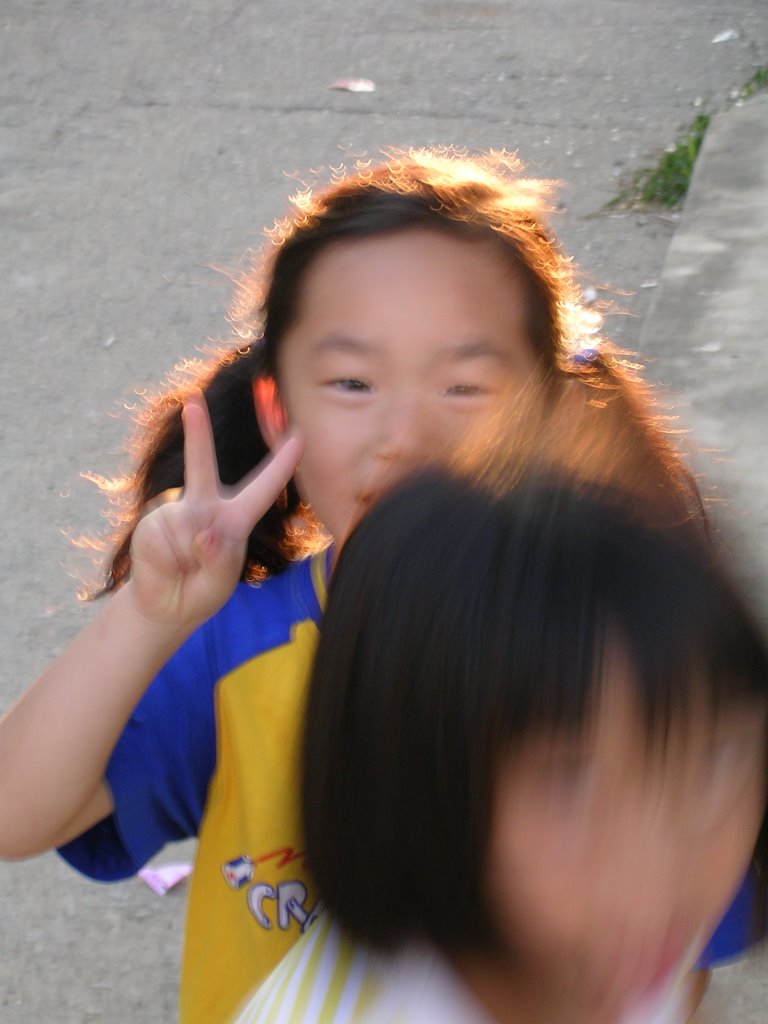
CHILD: 의국인! [Foreigner]
SECOND CHILD: [sing-songy] Hello!
MAN: [smiling] Hello.
ALL CHILDREN: [gleefully] Hello! Hello!
MAN: [speaking slowly] Can you speak English?
The CHILDREN suddenly start to giggle uproariously. But their amusement is more a symptom of shyness than a desire to carry the game any further. They run away, still laughing.
The MAN continues walking. He makes his way through small, sad, empty streets.

V.O.: Chris Marker once asked how we can remember thirst. What I want to know is, how can we remember loneliness? It penetrates not just oneself but the world. Reality itself appears changed. The side-streets suck themselves empty, their noise vacuumed behind shuttered store-fronts. The sky pulls itself as taut as a blue drum. The clouds starve themselves and harm themselves, like self-loathing anorexics.
And as the world seems to change, so does the self: feel lonely enough, and that juncture of soul and body that comprises what you think of as you becomes as parched as cracked soil. The lonely individual is ancient, he is dirt.
INT. AN EVANGELICAL CHURCH. TEN MINUTES LATER.

The MAN enters. He is somewhat surprised to see a CROWD OF WORSHIPPERS. They are very involved in their prayers.
The MAN walks cautiously forward.
A MIDDLE-AGED KOREAN MAN spots him.
CUT TO: CLOSE UP of MIDDLE-AGED KOREAN MAN.
MIDDLE-AGED KOREAN MAN: 하느님! 하느님이 자를 사랑하습니다! [God! God loves you!]
The MAN pulls back, alarmed.
EXT. A STREET. MOMENTS LATER.
The MAN is walking by himself again. He looks even sadder than before. A DIFFERENT CHILD spots him.
DIFFERENT CHILD: [especially enthusiastically] Hello!
V.O.: I don't know what it is was about that kid's voice. It went to my heart -- pierced it, like an exquisitely fine spear, the sharp end of sweetness. And it was this strange combination of sensations -- the needle's prick and the blood's sunny melt -- that suddenly transported me (there's no other phrase) to a different time. It was a time in the more recent past, when I still felt the residual parch of loneliness. But it was a time when I started to feel.
I mean, it was a time when I started to feel again.

Subscribe to:
Posts (Atom)