Wednesday, May 18, 2011

Democracy Evolutions 3 -- Into The Age of the Santorumites

On May 17, a story ran that quoted Rick Santorum as criticizing John McCain [see post] for not understanding, in the words of the article, "how effective waterboarding and other harsh interrrogation techniques can be". What followed what a field day of Internet commentary, ridiculing Santorum.


I don't doubt Santorum is, as people put it, "an idiot". But that doesn't mean his argument -- or the arguments of waterboarding enthusiasts generally -- won't have a discernable effect on public discourse. Part of the problem, it seems to me, is the pro-torture argument isn't countered with sufficient rigour. Personally, I thought McCain's speech was quite strong. Note, though, that it's not winning over people like Santorum, who want to place the discussion in terms of some weird kind of utilitarian framework.


image source: Wikipedia


McCain is right: if America clearly rejects torture, it takes a clear moral stance. But I suppose that Santorum et al think their own "realism" is founded in morality, too. The anti-torture argument stumbles when it confronts this kind of mindset. 

I wish McCain would also call into question one of the murkiest areas of political morality: the Realpolitik of geopolitics-based war. We still don't know enough about the origins of the wars in Afghanistan/Iraq. Why did the Bush administration act so passively in terms of shutting down al Qaeda before 9/11? Or if that smacks of being overly conspiracy-esque, why did it choose a disordered, half-hearted strategy when bin Laden was first on the run in Tora Bora? Bush once revealingly commented he "didn't much care" where bin Laden was while the Iraq war was revving up. Yep.


art: Finn Harvor


Waterboarding would not have been necessary if bin Laden had been caught much more quickly and al Qaeda dismantled more vigourously. The ex-Afghan intel chief is now saying he knew bin Laden was in Pakistan four years ago. That's smack in the middle of Bush's second term.


This issue, incidentally, can be seen from an artistic-aesthetic perspective; what is at work here is partly the news cycle working another lump of political gristle through the hardened tubes of its digestive tract. But it is also, to my mind, a quintessential example of Kulturkampf. As night follows day, conservatives who are inclined the same way as Santorum will find new ways to justify the laws and practices they are already in favour of. Progressives -- known to conservatives sneeringly as "liberals", or, even worse, "socialists" -- will counter those arguments. But neither side will win many converts from the opposing camp. The discourse of politics is largely the discourse of opposing teams, each seeking advantage on the field of elective play.  They are not trying to speak to each other; they are trying to speak to each party's respective base, and those who are undecided.


Artistic discourse tends to feel uncomfortable with all this even as it takes sides -- usually (but not always) with the left. When conservatives speak disparagingly about liberals they are often speaking about a personality whose type par excellence is the professionally successful artist. But art-liberalism of this sort itself needs to be analyzed with care, because it comprises only one element of the left-leaning population, and it probably is not, despite its beliefs about itself otherwise, a particularly effective element of the left.


Why should it be? Not only does North American art discourse play footsie with politics, making art "about issues" while shiftily avoiding commitment to the idea of explicitly political art, it tends to trade in rather general ideas that at times veer toward cliche. War is bad. Conservatives are dopes. Support green enterprise.


In this universe of predictable, complexity-free cultural production, the administration of George W. Bush makes a tempting target. However, artists-creating-commentary do not produce art that is particularly effective because it itself commits the same fundamental error as the conservatives it criticizes: it is uninformed. Bush was not a bad president merely because he waged an unnecessary war or because he "funded" it by cutting taxes; he is a bad president because his administration was pseudo-democratic. In the name of saving democracy, it ratcheted back its institutions several dangerous notches. America is still not back on an even keel. It is off-center -- politically, culturally, economically. But being off-center happens to suit conservatives who are serious about manipulating public opinion rather than treating it with respect. One result of this has been, for example, an enervated anti-war movement in the U.S. The three(!) wars the U.S. is now engaged in are treated as missions to be managed, rather than part of an overarching geopolitical policy that needs analysis. 


What is current U.S. foreign policy? We don't know in any holistic way. And what was it under George W. Bush's administration? We don't know that, either. By contrast, the Korean War -- and the Cold War it helped turbo-charge -- existed within the framework of policy papers such as NSC-68. This is how governments in fact organize themselves. Yet when one listens to the criticisms by artist-progressives of politician-conservatives, the rhetoric is often as simple-minded as one finds at the most key-board thumping blogs: the discussion is all about who is an "idiot" or not.


Look at the policy, and demand that all policy related to these wars be made transparent. That may or may not provide some shocking answers, but the odds are that at least enough information will be revealed to show that torture techniques are not in fact necessary if a war against a small, albeit tenacious and dangerous enemy is waged in a way to win as fast as possible, rather than to nurse the conflict along.




Tuesday, May 17, 2011

5.18 광주 민주화 운동 -- The Gwangju Democratization Movement

Today is the 31st anniversary of the The Gwangju Uprising. It is otherwise known as the Gwangju Massacre, though the Korean translates from 5.18 광주 민주화 운동  to the May 18th Gwangju Democratization Movement.

Monday, May 16, 2011

Noteworthy

War crimes in Iraq (via Jacob Russell)

The privatized army/security complex here to stay.

Amrullah Saleh knew where bin Laden was.

Top Shelf does Stockholm,

Democracy Evolutions -- The May 16th, 1961 Park Jung-hee coup


Today is the 50th anniversary of the Park Jung-hee coup d'etat. Although the story received a long editorial in the English-language paper I usually buy (The Korea Herald), it's received little attention in the English-language expat blogs, at least that I've been able to find so far. In Korean, the top news site by net ranking is this Ohmynews piece. 


At the school where I work, there was no mention of the coup. Yesterday was Teachers' Day, and today is "Adult Day" (this is an awkward translation -- it really means Age of Majority Day, though it refers to anyone who reached 21 within the past twelve months. Lots of flowers are being sold.) In fact, I would have missed the anniversary altogether if I hadn't bought a paper this evening. In two days will be another anniversary that is a milestone in the development of  South Korean democracy: the May 18th Gwangju Uprising. This warranted a screening at my school of 화려한 휴가 [The Splendid Holiday], a very affecting 2007 film directed by Kim Ji-hoon. But I'm not sure there will be much in the way of references to it on campus beyond this.


The May 16, 1961 coup was a regression; an usurpation of a student-led, non-violent revolution that took place some months before, and overthrew the dictatorial Syngman Rhee. But the 5.16 coup still has its apologists, who in turn call it a revolution in an attempt to win the lexical-political game of transforming reaction into something labelled progress. Some of these tensions are covered in the following article, from Korean, at the Daum website.


Friday, May 13, 2011

Democracy Evolutions - 1

At the Yahoo homepage, buried beneath stories about MLPs (the acronym, apparently, doesn't need to be explained) throwing funny pitches, basketball players dunking amazing shots, the royal couple's honeymoon, "the best supermarket coffee brands". and Charlie Sheen, was a story about John McCain and former U.S. attorney general Michael Mukasey and the use of torture by the CIA and military in order to gain intelligence. In the story, McCain was quoted from a speech he gave in the Senate about torture and its role in garnering information that was useful in tracking down Osama bin Laden. He stated that he had contacted the CIA director Leon Panetta to find out if "harsh interrogation techniques" had revealed the name of bin Laden's courier, Abu Ahmed al-Kuwaiti. Panetta said these techniques had not, since the information came from a detainee in another country.


McCain's speech was quickly denounced by Michael Mukasey. Mukasey's said without elaboration that McCain "is simply incorrect", and added that "harsh interrogation techniques were both effective and lawful". Mukasey's sensitivity to the putative legality of forms of torture is not surprising: he was the last attorney general in the George W. Bush administration.


At the heart of McCain's speech was a plea for the maintenance of moral standards. McCain said: "Ultimately, this is about morality. What is at stake here is the very idea of America — the America whose values have inspired the world and instilled in the hearts of its citizens the certainty that, no matter how hard we fight, no matter how dangerous our adversary, in the course of vanquishing our enemies we do not compromise our deepest values." 


Michael Mukasey's parsing of the distinction between "harsh interrogation" and torture or legal and illegal torture is not a discourse one would have found at the senior levels of a Western legislature several years ago. Torture has entered what might be termed the lexicon of allowability ever since 9/11, and it often now appears as a scriptwriter-sanctioned plot device in TV shows like 24. 

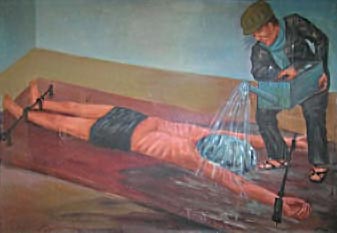
File:Waterboard3-small.jpg 


The above image is taken from the entry for waterboarding at Wikipedia (the painting is by Vann Nath, who was a prisoner at the Tuol Sleng death camp during the Khmer Rouge regime in Cambodia). The entry itself simply refers to waterboarding as torture. The neutrality of the entry has, according to a Wikipedia banner, been disputed. One has to wonder where the disputation comes from.

The idea that democratic countries could engage in the same barbarities as one of the most murderous regimes of the 20th Century does not seem to make sense. It is a sign of how much slippage has occurred in thinking on this subject in the 21st Century; presumably, Michael Mukasey is not defending Khmer techniques, he is defending in his mind lawful and effective ones. Yet there it is -- the torture technique is essentially the same, no matter who practices it. So the questions become: can torture be practiced in a controlled manner that does not erode the essentially decent character of a democratic society? Is torture a stallion that can be ridden?

[to be continued]

Noteworthy

Clark Blaise on the importance of short fiction's first blips

Doug Allan on the ongoing move to privatize health care in Canada.

Michael Bryson on John Lavery.

Wednesday, May 11, 2011

Fascism in 1930s America

Black_Legion
Michael Kleen on fascist movements -- both exported from Europe, in the form of the pro-German Bund, and domestic, such as the Black Legion [above] -- in the United States during the Great Depression.

Kleen:

One such group was the Black Legion, a secret offshoot of the Midwestern Ku Klux Klan. An Ohioan named Dr. William Jacob Shepard formed the Legion during the late 1920s, but never intended the group to take on a life of its own. He was a Northerner who idolized the old South, and he “spouted, and apparently believed, the most rotund platitudes about southern chivalry.”[xxx] He was also a baptized Catholic who hated Catholics, and a doctor who did not shy away from violence.
His Black Legion donned black robes instead of white and held secret initiation rituals. “They were asked to endorse the standard nativist anti-immigrant, anti-Negro, and anti-Catholic positions,” Amann explained, and “pledge support to lynch law.”[xxxi] Initiates were often coaxed or deceived into coming to meetings, and then threatened with death if they did not join.[xxxii] The membership of the Legion was spread across Ohio, Indiana, Michigan, and parts of Illinois, and the majority of members were urban and working class.[xxxiii]
The Black Legion became more violent and more revolutionary as time went on, bringing them closer to the European fascist model. Bert Effinger, their defacto leader during the 1930s, even planned “to kill one million Jews by planting in every American synagogue during Yon Kippur time-clock devices that would simultaneously release mustard gas.”[xxxiv]

read the whole thing here.

Monday, May 09, 2011

Noteworthy

Beatrice on Helon Haliba.

Dan Wagstaff on Penguin book covers, esp. that of Titus Groan. (nb. We used to have this book in our house; I'm fairly sure the cover art is a drawing by Peake -- my understanding is he did sketches of the characters in his novels.)

Friday, May 06, 2011

Loveography: Inside Haemi Fortress


EXT. A SMALL KOREAN VILLAGE. AN EARLY SUMMER EVENING, MID-WEEK.

A WESTERN MAN is walking down the city's main street. To his left is Haemi Fortress, a medieval Korean fort. Its wall is built of unevenly-matched stones, each lightened by age to a gentle ochre, as if the stone itself has softened.

Time to Make a Link

김영하의 책읽는 시작  -- Korean author Kim Young-Ha's Time to Read a Book blog, as well as photos from his album

Tuesday, May 03, 2011

Peace in time of Long War

Levi Asher responds to Nicholson Baker's article, "Why I am a Pacifist". The post went up just hours before the news of Osama bin Laden's assassination was made public. An interesting comments thread ensues.